
For many small business owners, hiring support feels like something that comes after growth. They believe they need more revenue or predictable cash flow before they have enough room to bring in support. That assumption can cause owners to overlook a question: What if the money needed for support is already inside the business? Financial clarity and small business outsourcing are closely connected. Understanding where money is going can reveal opportunities to improve profitability and where support could create a meaningful return.
For owners considering how to add capacity, the question may not be, “Can I afford support?” It may be, “Where could an investment in support create the greatest value?”
Start With the Money Already in the Business
More revenue does not automatically mean more profit or cash available to invest.
A business can generate more sales while the owner still feels like money is disappearing. Expenses, cash timing, pricing and staffing decisions can all affect the return on that revenue.
“Business owners often ask, ‘Where did the money go?’” says Debra Angilletta, author of Hidden Profits: Stop Chasing Cash – Predictable Profit in 90 Days.“ Before assuming the answer is that they need more revenue, they need to understand what is actually happening with the money they already generate.”
That starts with visibility into revenue, expenses, profit and cash flow. Pricing, expenses and staffing can reveal opportunities to improve margins and redirect resources toward a better return. The goal isn’t simply to cut costs, but to understand which costs produce value and where money could be put to better use.
How Does Cash Flow Affect Small Business Outsourcing and Hiring?
Profitability and cash flow are related, but they are not interchangeable.
A business may be profitable on paper while still experiencing periods when cash is tight. The timing of customer payments, payroll, contractor expenses and taxes can affect whether an owner feels comfortable taking on another expense.
Before adding a resource, an owner needs to understand the ongoing cost and financial capacity to sustain it. But cost is only one side of the equation. If outsourcing creates capacity for revenue-generating work or strategic decisions, the cost should be considered alongside the value of that capacity. Once an owner has a clearer view of profit and cash flow, the next question is not simply whether there is money available. It is where that money can create the most meaningful return for the business.
You’ve Found the Money. Now What?
Finding hidden profit isn’t the end goal. The value comes from deciding where that financial room can create the greatest return. The decision may involve strengthening cash reserves, making another financial investment or investing in people, technology or support to create capacity. That decision requires another calculation: What is the owner’s time worth, and where does that time create the greatest value?
Look at the Value of the Owner’s Time
Elizabeth Eiss, founder and CEO of ResultsResourcing, focuses on this distinction through the concept of spending versus investing time.
ResultsResourcing’s Value of Time Calculator helps business owners put a dollar value on their time and consider where it is being spent versus invested.
“If an owner spends hours every week on work that someone else can effectively handle, the cost isn’t only the support,” says Eiss. “There is also an opportunity cost associated with what the owner could have accomplished with that time.”
That doesn’t mean every task should be outsourced. The distinction is between work that requires the owner’s expertise and work that needs to get done but doesn’t require the owner’s direct involvement.
An owner may be capable of handling scheduling, research, administrative work or project coordination. But capability isn’t necessarily the best reason to keep doing something. The question is whether the work requires the owner’s expertise.
Where Should Small Business Outsourcing Begin?
This is where small business outsourcing becomes strategic. Rather than beginning with “I need a VA,” owners can begin with the work and desired outcome:
- What work directly contributes to revenue or customer value?
- What work needs to get done but doesn’t require the owner’s involvement?
- What could be eliminated?
- What could be automated or supported with technology?
- What requires human judgment, expertise or accountability?
- What outcome should additional support create?
The answer will vary by business. One owner may need a virtual assistant for administrative work; another may need a bookkeeper, project manager, marketing specialist or flexible team. The important decision isn’t simply who to hire. It is what problem the business is trying to solve and what type of resource fits that problem.
Make the Investment Work Harder
The goal of outsourcing isn’t simply to remove tasks from an owner’s calendar. The capacity it creates needs to be used well.
If an owner saves five hours a week on administrative work but fills those hours with more low-value tasks, the economics may not change much. If those hours go toward business development, customer retention or other high-value activities, the potential return looks very different.
The right support model also considers process, technology and people. Some work may first need a better process. Some can be automated with technology or AI. Other work requires human judgment, context, expertise or accountability. The objective is to find the right combination rather than defaulting to either technology or people.
For more on this approach, see ResultsResourcing’s The Blueprint to Future Proof Your Business Starts with Smart Delegation and Human + Digital: The Smarter Path to Scaling for Solopreneurs and Small Businesses.
Financial Clarity and Capacity Belong in the Same Conversation
Angilletta’s perspective starts with the numbers and financial clarity. Eiss’s starts with the work, the value of the owner’s time and where outside support can create capacity.
The goal isn’t to hire simply because the owner is busy. It’s to make a deliberate investment when the financial opportunity, the value of the owner’s time and the potential business outcome make the decision worthwhile.
The investment in support should create capacity for better execution, new opportunities and greater revenue or profit potential, rather than simply asking the owner to take on more work.
Find the money. Invest it thoughtfully. Use the capacity it creates to do more of the work that moves the business forward.
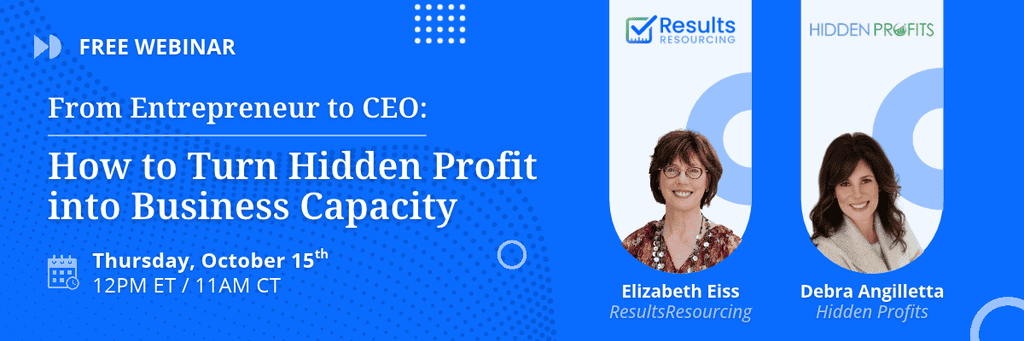
If you want to explore how hidden profit, cash-flow visibility, and strategic support decisions can work together, join Elizabeth Eiss and Debra Angilletta for the live webinar, “From Entrepreneur to CEO: How to Turn Hidden Profit Into Business Capacity.” You will leave with a clearer way to evaluate where money is going, what your time is worth, and where added support can create a meaningful return.