
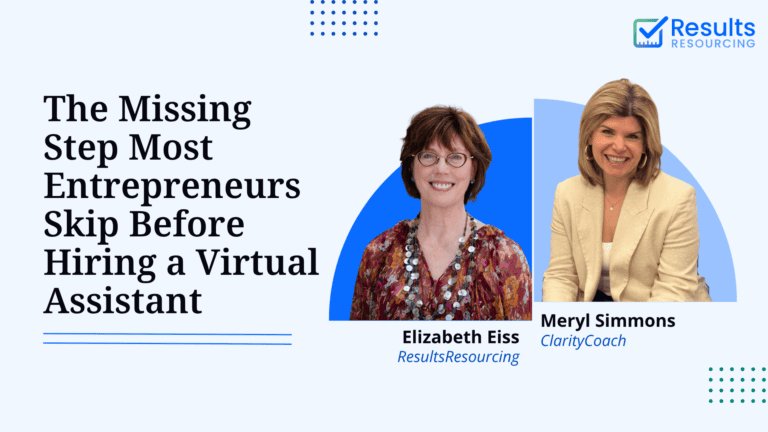
When the calendar is full, the inbox never seems to empty, and every day is spent moving from one urgent task to the next – hiring a virtual assistant feels like the natural next step. Sometimes bringing in support creates the capacity a business needs. Other times, it creates new frustrations. The issue is rarely the virtual assistant. More often, the business lacks the clarity, priorities, and structure needed for someone else to step in successfully.
According to Meryl Simmons, founder of ClarityCoach, and Elizabeth Eiss, founder of ResultsResourcing, successful delegation starts well before the hiring process. Businesses that get the greatest value from virtual assistants first establish three foundational elements:
- Clarity around what the owner should continue to own.
- Focus on the priorities that move the business forward.
- Structure that defines responsibilities before filling a role.
Together, these three steps create a stronger foundation for delegation and long-term growth.
Step 1: Delegate and Elevate to Create Clarity
Many entrepreneurs become the “Chief Everything Officer.” They schedule meetings, qualify leads, follow up with prospects, manage projects, and solve day-to-day problems across the business. While that level of involvement may be necessary in the early stages, it eventually becomes a barrier to growth.
One of the first exercises Meryl works through with clients is Delegate and Elevate, a framework that helps business owners evaluate how they spend their time and identify which responsibilities truly require their involvement.
“If you’re doing work you’re good at but hate doing, that’s something to delegate as soon as you’re able to,” says Meryl. “If you’re doing work you’re bad at and don’t enjoy, that’s even more important to remove. Your business benefits when you spend more time operating in your unique strengths.”
The exercise encourages business owners to evaluate every responsibility through a simple lens:
- Should it continue to be owned by me?
- Could it be delegated?
- Could it be improved through technology or AI?
- Has it become unnecessary altogether?
Creating that clarity helps entrepreneurs prepare for delegation with intention instead of simply looking for someone to take work off their plate.
Elizabeth approaches the same challenge from an operational perspective. “Delegate outcomes, not tasks.”
“When business owners focus their intention on outcomes instead of activities, they create better ownership, and in turn better execution,” Elizabeth explains. “That gives people the ability to make decisions, solve problems, and focus on the work that moves the business forward.”
Step 2: Establish Vision and Priorities Before Delegating
Once business owners understand what should leave their plate, the next step is determining what deserves the team’s attention first.
One of the biggest challenges Meryl sees is that everything begins to feel equally important. New ideas, customer requests, operational issues, and long-term initiatives all compete for attention, making it difficult to stay focused on meaningful progress.
“When everything feels important, it’s almost impossible to delegate well,” Meryl says. “Without clear priorities, business owners end up handing off work instead of creating ownership.”
Through her Get Focused™ process, Meryl helps entrepreneurs identify three to five priorities for the next 90 days. Those priorities become the roadmap for the quarter, while larger initiatives are broken into manageable milestones with clear expectations and deadlines.
“Vision without action is just a daydream,” Meryl says. “Action without focus is simply being busy.”
Clear priorities don’t just help the owner. They also provide direction for everyone supporting the business. When goals are defined, virtual assistants understand where to invest their time, which projects deserve attention first, and how their work contributes to business growth.
Step 3: Conduct a Business Function Audit Before Filling a Role
Hiring often happens when the business reaches a breaking point.
The workload becomes overwhelming, so the immediate response is to find someone who can help. Without a clear understanding of what the business actually needs, that new hire often becomes another person looking to the owner for direction.
A Business Function Audit helps entrepreneurs step back and evaluate the business before adding another person. One of the tools Meryl uses during this process is the Accountability Chart™, which maps the core functions of the business and clarifies who should own each responsibility.
“It helps founders prioritize where they need to let go first,” Meryl explains. “It also helps them visualize what each function should own and what success looks like for that seat.”
This exercise shifts hiring decisions away from immediate workload and toward long-term business goals.
Rather than assigning responsibilities based on who is already available, entrepreneurs can identify where the business is underserved, where ownership is unclear, and what type of support is actually needed.
It also helps answer important questions:
- Does this responsibility belong to the owner?
- Should it become part of an existing role?
- Is it best suited for a virtual assistant?
- Could technology or AI handle part of the work?
- Does the business need a combination of resources?
Turning Structure Into Action
This is where Elizabeth often sees the difference between businesses that gain immediate value from outsourcing and those that struggle.
Small business owners often overlook process as a business asset,” Elizabeth says. “Without clear processes, it’s easy to hire for the wrong role, assign work that doesn’t move the business forward, or bring in someone to do work that could have been improved through better systems or technology.”
ResultsResourcing approaches delegation through its Process-Tools-People (P-T-P) methodology.
- Process: Define, document, and standardize repeatable workflows.
- Tools: Identify where technology and AI can improve efficiency and reduce repetitive work.
- People: Match the right people to the work that requires human judgment, creativity, communication, and decision-making.
“The clients who see the fastest results usually have some aspect of that foundation already in place,” Elizabeth says. “When process and technology are addressed first, people can focus on the work where they create the greatest value.”
That philosophy reflects ResultsResourcing’s Human Premium™ approach. AI and technology are powerful tools, but they don’t replace the people who design the process, ask the right questions, apply experience, and make informed decisions. By combining well-defined processes, practical technology, and skilled people, businesses create an environment where technology enhances human expertise to drive better business outcomes.
Building the Foundation Before Hiring Support
Hiring a virtual assistant is an important milestone for many growing businesses, but it shouldn’t be the first step in solving an overwhelming workload.
Businesses that delegate successfully first create clarity around what the owner should own, establish priorities that guide the team’s work, and build a structure that defines ownership across the organization.
Those steps make it easier to determine what should be delegated, who should own it, and how support can contribute to meaningful business growth.
Entrepreneurs interested in learning more about these frameworks can continue the conversation with Meryl Simmons of ClarityCoach and Elizabeth Eiss of ResultsResourcing.
Interested in learning more? Watch the webinar replay where these experts share practical approaches to building the clarity, focus, and structure that help businesses delegate effectively and scale with confidence.